








In England, schools usually pay for sensory equipment from their own budget: a mainstream school is expected to meet the extra cost of support for each pupil with special educational needs (SEN) up to £6,000 a year, and the local authority adds high needs top-up funding above that, normally for pupils with an education, health and care plan (EHCP). This guide explains SEN funding and other funding for sensory equipment open to state schools and nurseries in England in 2026–27, from the notional SEN budget to early years funds, pupil premium, capital funding and fundraising. It is for SENCOs (special educational needs coordinators), teachers, nursery managers and school business managers.
This is not financial advice, so check the details with your SENCO, school business manager or local authority. To see what schools order most, browse our sensory equipment for schools.
SEN funding: the notional SEN budget
Mainstream schools are funded for most pupils with SEN through their core budget, within which the local authority identifies a notional SEN budget for each school. The notional SEN budget guidance for 2026 to 2027 from the Department for Education (DfE) says:
- It is not a separate pot. It sits inside a maintained school’s budget share or an academy’s general annual grant, as a guide to spending, not a target or a limit.
- The £6,000 threshold. The school is expected to meet the extra cost of support for each pupil with SEN up to £6,000 a year, counting only costs above the basic provision every pupil gets.
- Not £6,000 for every pupil. Most pupils’ support costs less than that.
- What it covers. Provision for pupils on SEN support (pupils with SEN who do not have an EHCP), and a contribution towards provision for pupils with high needs.
- Reasonable adjustments. Schools must make reasonable adjustments for disabled pupils under the Equality Act 2010. If the adjustment counts as special educational provision, the guidance allows its day-to-day (revenue) cost to come from the SEN budget.
The DfE expects the SENCO to help senior leaders decide how it is spent, so start with your SENCO.
Tip: your local authority’s SEND (special educational needs and disabilities) Local Offer website sets out how it funds children and young people with SEN.
High needs top-up funding and EHCPs
An EHCP is for children and young people up to age 25 who need more support than SEN support can provide. The GOV.UK guide to EHC plans explains that the plan records the child’s education, health and care needs and the extra help to meet them. Parents, young people aged 16 to 25 and others, including teachers, can ask the local authority for an EHC needs assessment.
- Top-up funding. In a mainstream school, the local authority pays top-up funding from its high needs budget for costs above £6,000 a year, normally when an EHCP is in place. It can also provide high needs funding up to age 19 outside the statutory assessment process.
- The local authority’s duty. Under the Children and Families Act 2014, it must secure the special educational provision set out in the plan, and review the plan at least every 12 months.
- Special schools. In 2026–27, places are funded at £10,000 each, with top-up funding for each pupil on top.
An EHCP is a plan, not a pot of money. If a pupil with a plan needs particular equipment, the SENCO can check what the plan says and whether to raise it at the annual review.
The inclusive mainstream fund (2026–27)
For 2026–27, mainstream schools also receive a separate grant, the inclusive mainstream fund. Its conditions of grant say schools must use it with their core funding, including the notional SEN budget, to make their provision more inclusive and remove common barriers to learning, including for pupils with SEND.
- It can only go on evidence-informed activities that fit at least one of seven DfE principles of inclusion, one of which covers inclusive environments and accessibility.
- It cannot pay for general running costs, activities that were already happening, staff time unrelated to inclusion, or capital works.
- It must be used by 31 March 2028.
- Every school that receives it must publish an inclusion strategy statement for 2026–27 by 31 December 2026, showing the activities funded and their budgeted costs.
Whether a purchase fits these rules is for your school’s leaders to decide.
Nurseries and early years settings
Nurseries, pre-schools and childminders offering the government-funded hours can receive SEN-related funding through the local authority. The DfE’s early years funding guide for 2026 to 2027 covers the first two streams:
- SEN inclusion fund. Every local authority is required to have one for children below compulsory school age with SEN, however many funded hours they take, aimed at lower-level or emerging needs. It should publish who is eligible and how providers apply.
- Disability Access Fund. For children who get Disability Living Allowance and take up funded hours, but not children in school Reception classes. In 2026–27 the local authority must pay the provider at least £975 a year per eligible child, as a lump sum, which can go on reasonable adjustments, staff training and resources to support the child.
- Inclusive early years fund. New for 2026–27: £47 million nationally, which providers were due to receive as a lump sum before the end of September 2026, for planning, workforce development, and adaptations or resources for an inclusive environment. The DfE recommends about £1,000 per setting, and local authorities do not have to fund every provider.
The early years pupil premium adds at least £1.15 an hour on the first 15 hours for eligible children. Ask your local authority’s early years team how each fund works locally.
Pupil premium
Pupil premium is extra DfE funding for the education of disadvantaged pupils: those who are or have been recorded as eligible for free school meals in the past 6 years, and children previously looked after by a local authority or other state care. Pupils newly eligible for free school meals through the 2026 expansion to all Universal Credit households do not attract it. In 2026–27 schools receive £1,550 per eligible primary-aged pupil, £1,100 per eligible secondary-aged pupil and £2,690 per previously looked-after pupil.
The DfE’s pupil premium guidance says it must go on evidence-informed activities in line with its “menu of approaches”: high-quality teaching, targeted academic support, and tackling non-academic barriers such as attendance, behaviour and wellbeing. It need not be spent only on the pupils who attract it, and each school publishes a yearly statement on its use.
Sensory room funding: bigger projects
If you are working out how to fund a sensory room, separate the building work (blackout, electrics, flooring, fixings) from the equipment, which can be bought in stages. Your school business manager will know which costs count as capital.
- Devolved formula capital. Schools get a yearly capital allocation for looking after their buildings and for small capital projects. The DfE’s 2026–27 guidance says each school decides how to use it, for example on building improvements, information technology and minor works. It must be spent on capital, and each allocation can be used over three financial years.

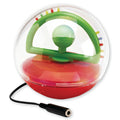
The LED Magic Power Globe (switch adapted), one of the products schools order most from us, shows spinning, multi-coloured LED light patterns and can be turned on with a switch (it takes a 1/4 inch jack plug). It needs 4 x AA batteries, which are included. See our sensory rooms in schools planning guide and sensory room equipment.
Fundraising and donations
Some schools raise money for extras such as a sensory room:
- Your PTA (parent teacher association): ask for something specific, such as a named kit, so parents can see what their money buys.
- Local businesses: some sponsor or donate to nearby schools.
- Community grants: councils, community funds and trusts sometimes run small schemes. Check whether they cover equipment the school is expected to provide.
- School events: fairs, sponsored walks and non-uniform days.
Follow your school’s policy on donations, record what each gift paid for, and show donors the result, within your photo consent rules.

The Dark Den Time Fun Kit suits a wish list: a fun kit bag with a Prismatic Projector, a Fibre Optic Ice Lamp, a Magic Power Ball, a Colour Changing Egg, a Laser Light Ball and more.
What is changing: SEND reform
Everything above is the system in force in October 2026. Bigger changes are proposed, and most need new legislation.
- Proposals. The schools white paper, Every child achieving and thriving, and a consultation, SEND reform: putting children and young people first, were published on 23 February 2026. The consultation closed on 18 May 2026; on 28 October 2026 the government’s response had not been published.
- What is proposed. EHCPs kept for children with the most complex needs, new Individual Support Plans (a digital record of needs) for all children with SEND, and, after legislation, more SEND funding going straight into schools’ core budgets.
- Timing. An Education for All Bill was announced in the King’s Speech in May 2026; the DfE said this confirmed its intention to legislate but was not the introduction of legislation. It expects new legislation to take effect from September 2029, and says nothing will change for children who already have an EHCP until September 2030 at the earliest.
The inclusive mainstream fund and inclusive early years fund are already in place for 2026–27.
Making the case to your head or governors
A short, costed plan makes the decision easier. Cover:
- Who will use it: which pupils, how often, and which staff.
- What you will see: how it will be used, not promised results, such as “Year 2 will use the den for short planned visits each afternoon”.
- Where it will live: the room, corner or trolley, with storage and sockets.
- Care: cleaning, damage checks, batteries, and who is responsible.
- Cost and phasing: what you need now and what can wait.
- Links to plans: SEN support plans, EHCPs and your inclusion strategy.
- Advice: from the SENCO and, where a pupil has one, their occupational therapist (OT).

The ‘Lights & Sounds’ Bucket Time Kit, one of the products schools order most from us, is a lidded bucket of light-up and sound toys for bucket time, including a Police Light, a Flexi Design Spinning Light, a Light Up Tambourine and a Lights & Sounds Answer Buzzer. Age 3+. Items may be swapped for something of similar or higher value if stock runs short. Our kits are put together with the guidance of Jordan, our special needs teacher.
Ordering with a purchase order
Schools, nurseries and other organisations can order online with a purchase order (PO) number:
- In the basket, answer “Yes” to “Ordering for a school or organisation with a purchase order (PO) number?” and type your PO number.
- At checkout, choose the payment method “Purchase Order (Schools & Nurseries)”.
- We email you an invoice with your PO number on it.
Every price shows both ex VAT and inc VAT amounts. Standard UK delivery is free on orders over £45 ex VAT, and we aim to dispatch on the next working day. Large orders can be placed online, by email or by phone: call 01535 662812 or email info@exploreyoursenses.co.uk.

For a first order, consider the Vibrating Sensory Cushion, which vibrates gently when pressed and stops when released. It comes in ten colours and needs 2 x D batteries. Our schools and nurseries page has more kits and favourites.
Scotland, Wales and Northern Ireland
Each nation has its own system. In Scotland, the Education (Additional Support for Learning) (Scotland) Act 2004 gives education authorities a legal duty to identify pupils’ additional support needs, make provision for them and review them. Wales has an additional learning needs (ALN) system for ages 0 to 25, with support written into an individual development plan (IDP). In Northern Ireland, schools and the Education Authority (EA) share responsibility for securing SEN provision. Ask locally how funding for sensory equipment works there.
Questions teachers ask
Can we use our SEN budget to buy sensory equipment?
It is your school’s decision. The notional SEN budget is a guide to spending on extra support for pupils with SEN, with no list of approved items, so ask your SENCO and school business manager.
Does an EHCP pay for equipment?
An EHCP is a plan, not a school budget, though parents can ask the local authority about a personal budget. In a mainstream school, the school is expected to meet the first £6,000 a year of extra support costs and top-up funding covers costs above that, so ask your SENCO what the plan includes.
How do we fund a sensory room?
You can combine capital funding for building work, the school’s budget for equipment, and fundraising for extras. Our sensory rooms planning guide covers space, budget and safety.
Are EHCPs being scrapped?
No. They continue under current law, and the 2026 proposals would keep them for children with the most complex needs. See what is changing for the timetable.


