





Every EYFS (Early Years Foundation Stage) setting needs open-ended sensory resources: natural objects and treasure baskets, a tuff tray for messy play, light and dark, sound, texture, movement, cause and effect toys, a calm space and an outdoor area, plus a separate set of toys marked for under-3s. This guide to EYFS sensory resources is for nursery managers, childminders and Reception teachers. It gives three to five picks for each kind of sensory play, then covers storage, safety and budgets.
Each pick ends with the age mark from its product page, or “No age mark” if there is none: keep those items for over-3s. Browse all our early years sensory resources.
EYFS sensory resources and the areas of learning
The EYFS is the framework that nurseries, childminders and schools in England follow for children from birth to 5, including Reception. It has seven areas of learning. The three prime areas are communication and language; physical development; and personal, social and emotional development. The four specific areas are literacy, mathematics, understanding the world, and expressive arts and design. Sensory play runs through all seven: one tray of sand gives children something to talk about, scoop, share and count.
Nursery sensory toys for babies and toddlers (under 3)
All the picks below are marked for under-3s on their product pages. Babies explore with their mouths, so choose chunky, wipeable toys and stay close. Our baby sensory toys (0–3 years) range has more, but not every item in it is marked for under-3s, so check each one.

- Sensory Ball Set: four soft, textured balls from 90mm to 180mm across, to grasp, roll and crawl after. Age: 6 months+.
- Soft & Squeezy Critter Blocks: easy-to-clean, squeezy blocks with friendly animal faces and rounded corners, light enough to toss. Age: 6 months+.
- Cuddle Bell Ball: a huggable 200mm ball with an internal bell that tinkles whenever it moves. Age: 12 months+.
- Sensory Pop-Up Tissue Box: six sides to explore, such as a peek-a-boo bunny and a pull-through grid, with soft fabrics to pull out. Often ordered by schools and nurseries. Age: 12 months+.
- Early Stages Sensory Experiences Basket: a natural basket holding a Squeekaboo, a cage bell, an animal mirror, a space blanket, a juggling scarf and more. Contents may vary. Suitable from 18 months+.
Treasure baskets and natural materials
Many settings make a treasure basket for babies who can sit up: everyday and natural objects in a low basket, each too big to fit in a mouth and with no loose parts, washed and checked before every session, with an adult close by. Most of our ready-made natural sensory basket sets are marked 3+ or carry no age mark, so they belong in pre-school rooms and Reception. No pick below is marked for babies under 10 months.

- Rainbow Wooden Eggs: solid beechwood eggs in the seven colours of the rainbow, with a natural finish that shows the grain, to roll, sort and count. Age: 10 months+.
- Sensory Blocks: sixteen chunky wooden blocks, each with an insert of sand, water, beads or coloured acrylic to look into. Age: 18 months+.
- Natural Touchy Feely Basket: nine wooden and natural things to explore by touch, from wheeled wooden massagers to a loofah and a shaving brush, in a wicker basket. Often ordered by schools and nurseries. Age: 3 years+, so not for under-3s.
Messy play and tuff trays
On the floor or a low table, a tuff tray turns sand, water or gel into a shared activity. Most messy play products are marked 3+ or have no age mark, so plan separately for under-3s. There is plenty more in the messy and water play range and among our tuff tray accessories.

- Tuff Spot Tray: for indoor and outdoor play, such as messy play, a shallow sand pit or water trough, pattern making or painting. No age mark, though the page mentions pattern making with toddlers.
- Sensory Tray Play with Lid: fill it with sand, water or a small world scene, then put the silicone lid on to store it. Age: 18 months+.
- Coloured Magic Motion Sand: a 2.5kg bag of soft kinetic sand in green or blue, for farm fields or an ocean of sea creatures. Suitable for 3 years+.
- Happy Senso Multi Sensory Gel: cool, crackly and scented, in 300ml cans of mint fresh, original or tropical. One of the products schools order most from us. No age mark.
Light and dark
Light play needs somewhere dim, such as a den or a corner with the blinds down. Keep UV (ultraviolet) light for older children. See our dark den resources.

- Light Up Dark Den and Resource Kit: the den measures 1000mm each way and has a light-blocking cover. It comes with a mood light, an LED Multi Spinner and more. Age: 3+.
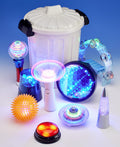
- Dark Den Time Fun Kit: light-up resources in a kit bag, among them a Prismatic Projector, a Fibre Optic Ice Lamp and a Colour Changing Egg. One of the products schools order most from us. No age mark.
- Rainbow Colour Blocks: a 24-piece set of see-through blocks (six shapes, four colours) to stack and look through. Age: 12 months+.
- UV Scarves and UV Blast Torch: three 600mm square scarves that shine in UV light, and a nine-LED torch, batteries (3 x AAA) included. Shine it at the scarves, never at faces. No age marks.
Sound and music
Give babies soft shakers they can hold, and older children real instruments to play. Our sensory musical instruments range has many more.

- Baby Maracas: 105mm maracas made for tiny hands, with a gentle, soft sound. Colours may vary. Age: 3 months+.
- Natural Children’s Percussion Basket: a wicker basket of instruments, including a wooden shaker tube, wooden maracas, bells, a beggars drum and a tambourine. Often ordered by schools and nurseries. No age mark.
- Noisy Time Fun Kit: a kit bag with ten items, among them a Football Rattle, a Train Whistle, a Groan Tube and a Sound Hose. One of the products schools order most from us. No age mark.
Touch and texture
Offer contrasts: soft and spiky, smooth and bumpy, squashy and firm. Let children choose how close they get. See our tactile sensory toys.
- Inny Bin: a cube strung with elastic bands, and six chunky, textured shapes to push through the bands. Age: 18 months+.
- Rainbow Tactile Wall Panel: five wooden panels forming a rainbow arch about 1620mm x 810mm, with ten activities, including gears, a bead maze and mirrors. Fixings are included; indoor use only. Age: 18 months+.
- Tactile Time Fun Kit: twelve textured things to squeeze, stretch and explore, including a Bushy Ball, a Hedgehog Ball and a Scrunchy Dinosaur. Often ordered by schools and nurseries. No age mark.
Movement and balance
Babies need floor space to roll and crawl; older children want to jump, balance and rock. Clear the floor, stay close and stop if a child is dizzy or upset. Some children seek movement and others avoid it: if the child has an occupational therapist (OT), ask them which activities suit that child. See our balance and movement range.

- Rainbow Soft Ball: a clear, soft 160mm ball with little coloured balls inside that tumble as it rolls. Age: 6 months+.
- Giant Activity Rings: nine rings in three sizes and three colours, embossed with Braille, for obstacle courses, jumping and throwing games. Designed for children aged 12 months and above.
- Teeter Popper: a rocker to sit, lie or stand on, with 14 suckers underneath that pop loudly as it moves on hard floors. Often ordered by schools and nurseries. Age: 3+.
Cause and effect
Pat a toy or turn a handle, and something happens straight away. The last two picks are for over-3s. Children who use a switch can join in with our switch adapted toys.
- Rainbow Spin Again: children slot coloured discs over the spindle and watch them twirl down to the base. Age: 12 months+.
- Tsum Tsum Light Up: pat or gently squeeze this small, soft Disney character and it blushes, its cheeks glowing while it chuckles or squeaks. Characters may vary. Age: 0+.
- Sensory Bumble Ball: once it is on, it moves about erratically and makes a noise. It needs 3 x AA batteries. One of the products schools order most from us. Age: 3+.
- Jack in the Box: wind the handle for a tune until the smiling clown pops up. No age mark.
Calm and cosy spaces
A calm space is a soft, quiet spot where a child chooses to take a break, never a punishment. Keep it small, with soft light and a few familiar things. See our guide to setting up a calm corner and our calming sensory toys.
- Exploration Square Cushions: four wipeable cushions, each 600mm square and 150mm high. Made in the UK: check the delivery time on its page. No age mark.
- Twilight Buddies Bunny: a soft toy, 290mm long, that casts a starry sky across the ceiling and walls. It has a 45 minute sleep timer. Keep it, like any soft toy or cushion, out of cots and sleep spaces, as the EYFS requires. Age: 0+.
- Children’s Ear Defenders: a folding 160g pair with a padded headband. Attenuation value: SNR 23.4 dB. One of the products schools order most from us. Suitable for babies over 6 months to 16 years old.
- Sensory Timer Selection: a set of three liquid timers, 100mm to 130mm high, in which oil and water droplets mark the time. Age: 3+.
Outdoor play and the sensory garden
Outdoors adds wind, weather, water and living things. A sensory garden can be one corner with windmills, chimes and a water tray. See our sensory garden and outdoor play range.

- Sensory Garden Discovery Tub: a tub of garden decorations that move and make sounds, including a bamboo chime, windsocks, windmills, bunting and a Butterfly Garden. Contents may vary. No age mark.
- Bubbles & Blow Time Fun Kit: sensory and touchable bubbles, a bubble gun, whistles, a kazoo and other things to blow. Often ordered by schools and nurseries. No age mark.
- Softie Marine Magnifiers: three soft foam animals with 2X lenses that float, so children can look closely at things in a water tray. Age: 18 months+.
Storing, rotating and cleaning resources
- Store by sense or activity in lidded boxes labelled with a photo, so children can help tidy up.
- Put out a small choice on low, open shelves and keep the rest in a cupboard.
- Rotate little and often. Keep favourites out.
- Clean as you go. Follow each product’s care notes, and put mouthed toys in a “to be cleaned” box, not back on the shelf.
- Keep kits together, each in its own bag with a contents list, and count pieces back in.
- Check batteries. Battery covers should be secure; remove batteries before long-term storage.
Safety: age marks, small parts and mouthing
- Read the age mark before a toy goes into a room. No age mark on the page? Keep the item for over-3s.
- Keep 3+ toys away from under-3s. A 3+ mark often means small parts, so keep those toys out of baby and toddler rooms and away from any older child who still mouths.
- Check kits item by item. Items in kits can carry their own age marks, and contents may vary.
- Supervise. Stay close during messy, water and movement play, and keep UV torches in adult hands.
- Look for damage before each session: splits, leaks, cracks and loose parts. Remove anything damaged straight away.
- Check allergy information before using anything scented.
Planning on a budget
Open-ended early years sensory toys work across ages, rooms and areas of learning, so start there:
- Buy the basics first: a tuff tray, textured balls, a parachute, a few instruments and a basket of natural objects.
- Use what you have: blackout fabric over a table makes a dark den. Check found objects for size and damage, as for any toy.
- Buy kits to save time: a kit puts a themed set in one bag.
- Add bigger items later, such as a den, a wall panel or soft seating.
Standard UK delivery is free on orders over £45 ex VAT. For funding, see how schools pay for sensory equipment.
Questions parents and teachers ask
What sensory resources does a nursery need?
Something for each sense: natural objects in a basket, a tuff tray, a dark space with a few lights, simple instruments, textured balls, room to move and a calm corner. Add a set marked for under-3s for the baby and toddler rooms, then follow your children’s interests.
Are sensory toys safe for babies?
Pick toys whose age mark covers the child’s age, such as 0+ or 6 months+ for young babies. Keep 3+ toys, and any without an age mark, out of baby and toddler rooms. Check toys for damage before each session, clean mouthed toys often and stay close while babies play.
How often should we rotate resources?
There is no fixed rule. Try swapping a few items every week or two and refreshing a whole area each half term, keeping favourites out. Notice which resources children go back to and which sit untouched.
Can nurseries pay by purchase order?
Yes. Schools, nurseries and other organisations can order with a purchase order (PO) number: answer “Yes” to the PO question in the basket, type the number, then choose “Purchase Order (Schools & Nurseries)” at checkout. See ordering for schools and nurseries.


