

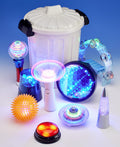




Good toys and gifts for autistic 9 to 12 year olds still give plenty of sensory feedback, but look grown-up enough for a school bag or bedroom shelf: discreet fidgets, putty, weighted lap pads, room lights, timers they run themselves and a hobby to get good at. If you are looking for toys for an autistic child age 10, or gifts for an autistic 12 year old who has gone off anything that looks babyish, this guide sorts our picks by need, with sizes, batteries and age marks taken from our product pages.
Every autistic child is different, so treat these ages loosely. Some 11 year olds still love bubble tubes and light-up spinners, which is completely fine, and our guide for 6 to 8 year olds has more ideas like that. For ready-made present ideas, see our gifts for autistic children.
What to look for at this age
- A more grown-up look. Towards the end of primary school, many children become more aware of what classmates think. Plain colours, smooth shapes and no cartoon faces make a fidget easier to use in front of friends.
- Quiet and pocket-sized. Something that fits in a blazer pocket or pencil case can come along to school, clubs, family visits and waiting rooms.
- Things they can control. Lamps with remotes, timers they set and putty in a lidded tin let a child manage their own space and time, which matters more as secondary school gets closer.
- The right weight for their size. Weighted items should suit the child. Our weighted lap pads, for example, come in 1kg for children up to 10 and 2kg for older children and adults.
- Their opinion. Show your child two or three product pages and let them pick. A present they chose is much more likely to be used.
Discreet fidget toys for autistic 9 to 12 year olds
These fidgets look more at home on a desk than in a toy box.

- Infinity Decompression Cube: a compact cube made of smaller linked cubes that can be turned from any angle, over and over, with just the fingers. Age 5+.
- Speks Gump stress balls: soft balls with a memory gel filling that can be squeezed, stretched and pinched, then return to their original shape. Choose the Original or the Gump Surface, which has raised textures for fingers to explore, is marked ages 3+ and is not designed as a chew toy. Colours vary unless you request one. Check them before use and throw away any that are damaged or leaking.
- Fidget Polygon: twelve sides of gears, buttons, a joystick, a switch and stress balls. It comes in black, green, orange or blue, and colours vary unless you specify one when ordering. Age 5+.
- Metallic Textured Tangle: a twisty Tangle with a metallic, textured finish that keeps fingers busy. Colours may vary. Age 3+.
- Koosh Ball: hundreds of rubber strands to run through the fingers, 85mm across and easy to catch.
There are many more in our fidget toys for autism and ADHD.
Tip: Keep one fidget in the school bag and a different one at home. Swapping them over every few weeks keeps both feeling new.
Putty and dough
Putty is one of the most grown-up fidgets around. It can be stretched, folded and squashed during homework, films or long car rides, then put away out of sight.

- Crazy Aaron’s Thinking Putty: a range of putties in different colours and textures, from bouncy and stretchy to sparkly and shimmering. Age 3+.
- Crazy Aaron’s Thinking Putty mini tins: Thinking Putty in pocket-sized mini tins. Designs include Shark, Owl, Starfish and Rose Gold, and tins are sent at random unless a design is requested. Age 3+.
- Aroma Dough: a dough made with beeswax, grape seed oil and cocoa butter, in six colours, each with its own essential oil scent: eucalyptus, peppermint, lemon, lime, bergamot or lavender. Each piece weighs about 60g.
Tip: Putty picks up fluff and hair if it is left out. Give it one home, such as a pencil case pocket, and make “lid on” part of putting it away.
Weighted lap pads, wraps and vibration
Weight and vibration give firm, steady sensory input that some children seek out. At this age, simple lap pads and wraps often go down better than weighted soft toys. Always use weighted resources under constant adult supervision.

- Weighted Lap Pads: lap pads to rest across the knees while reading, doing homework or watching a film, which can also be used over the shoulders. The 1kg pad (600mm x 300mm) is for children up to 10, and the 2kg pad (660mm x 510mm) is for older children and adults. Colours may vary.
- Weighted Shoulder Wrap: an 800g wrap, 1000mm long and 210mm wide, that sits across the shoulders and is easy to take anywhere.
- Weighted Soft Football: a 2lb soft football, 220mm across, for football fans who like holding something heavy. Age 3+.
- Vibrating Sensory Cushion: lean on it or squeeze it and it gives a gentle vibration; ease off and it stops. Of its ten colours, navy blue, silver and cream suit an older child’s room. It needs 2 x D batteries and was one of our best sellers last Christmas.
Compare sizes and weights across our weighted toys and lap pads.
Lights for a bedroom or den
Lighting is an easy way to make a bedroom feel like your child’s own space, and at this age many children like to be in charge of the settings.

- My Very Own Moon: a model moon with 12 illuminated lunar phases. Use the infrared remote to scroll through them automatically, or use the manual setting to match the moon outside, from new moon to full moon. It takes 4 x AA batteries in the moon and 2 x AAA in the remote, and switches itself off to save battery.
- Star Show Projector: hundreds of stars around the room, in white or in changing colours. It is compact at 105mm across and 120mm high, and the 3 x AA batteries are included. Popular last Christmas.
- Twister Lamp: a 200mm liquid-filled lamp in which a tornado-like vortex swirls through changing colours. Batteries are included.
- Crystal Music Ball Light: a disco ball that sends moving coloured lights around the room and plays music from a memory stick or SD card, with a remote for song choice and volume. It also works via Bluetooth, its lights react to sound, and it runs on mains power (240 volts).
- Colour Changing Crystal Light: this 100mm crystal with a textured surface works through a series of slow colour fades and fits easily on a bedside table. The 3 x AG13/LR44 batteries are included. Not suitable for under 3s. Popular last Christmas.
See more sensory projectors and room lighting.
Tip: If your child finds flashing light hard, test any new lamp together in daylight first and pick a steady or slow-fading setting.
Timers for more independence
Between 9 and 12, children are often expected to manage more for themselves: homework, screen time, getting ready in the morning. A visual timer shows how much time is left without an adult having to keep saying it.

- Time Tracker Visual Timer and Clock: a 230mm visual timer with coloured sections, each set to its own length of time. As time runs out it flashes and plays the sound effect you choose. It takes 4 x AA batteries.
- Twist Time Timer: twist to set any time up to 90 minutes, then watch it count down in digits and segments. It is silent apart from its alarm, and the magnetic back holds it on a fridge or any metal surface. It needs 1 x AAA battery, which is not included.
Find more in our visual timers and organisers.
Tip: Hand the timer over. When your child sets it and decides what happens at the alarm, it becomes their tool rather than another adult reminder.
Hobbies to get good at
A hobby gives a child something to practise, improve at and show off. These are easy to start and leave plenty of room to get better.

- Juggling Scarves: three lightweight scarves, each 600mm square, that float gently through the air, so they are easier to catch while learning.
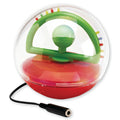
- Tai Chi Ball: a clear 200mm ball with a smaller ball inside on a circular track. Twist and turn it to keep the inner ball rolling along the track, then rest it on its stand.
Tip: Keep a record of personal bests, such as the most catches in a row, on the fridge. Beating their own score can feel better than competing with someone else.
Ear defenders for loud places
School discos, football matches, bonfire night and busy shopping centres can all be very loud. Many families keep a pair of ear defenders in the car or school bag for those moments.
Our Children’s Ear Defenders fold down to 120mm x 120mm x 95mm and weigh 160g. Their attenuation value is SNR 23.4 dB, they come in four colours, and their listed age range of 6 months to 16 years covers this whole age group. They were popular last Christmas. Try them at home while something noisy is going on, such as the hoover, before relying on them at a big event.
Playing together
- Ask them to teach you. If your child has learned a juggling pattern or a new putty trick, ask them to show you how. Being the expert feels good at any age.
- Do things side by side. Some children find face-to-face play hard work but enjoy doing something next to you, such as modelling dough at the kitchen table or watching a film with a lap pad each.
- Hand over the controls. On a family film night, let your child choose the lighting and run the remote.
- Set challenges, not rules. “How long can you keep the ball rolling?” invites play without pressure.
- Accept “maybe later”. A quick “want a go?” usually works better than insisting, and many children this age join in more when it is their choice.
Questions parents ask
What can I buy an autistic 12 year old for Christmas?
Choose something linked to what they love that doesn’t look like it came from the toddler aisle: the Crystal Music Ball Light for a music fan, My Very Own Moon for a space fan, a Speks Gump for the pencil case or a 2kg weighted lap pad for film nights. If you are unsure, let them choose between two or three. Our gift guide for autistic children has more ideas.
Is my 10 year old too old for sensory toys?
No. Sensory toys are simply things that are good to touch, watch, hear or move with, and plenty of adults keep a stress ball on their desk. What usually changes at this age is how a toy looks, not how much your child enjoys it, so look for plainer, more grown-up designs.
Which weighted lap pad suits a 9 to 12 year old?
Our Weighted Lap Pads come in 1kg, listed for children up to 10, and 2kg, listed for older children and adults. Always use weighted resources under constant adult supervision.
Will my child be allowed a fidget at secondary school?
It depends on the school. Talk to the SENCO before the move and ask how fidgets are used in lessons. Something plain and silent, such as putty in a tin or a stress ball, is usually easier to agree than a toy that clicks or lights up.


